


Photography's Holy Trinity: The Power of ISO, Shutter Speed, and Aperture

Updated: Nov 3, 2025
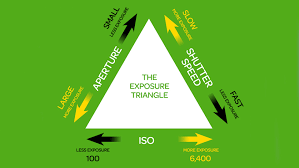
The "Triangle of Photography" is a fundamental concept in photography that highlights the interconnected relationship between three crucial components: ISO, shutter speed, and aperture. These three elements work together to control the exposure of an image, allowing photographers to achieve their desired results. Here's a detailed breakdown of each component and how they interact:
**ISO:**
ISO (International Organization for Standardization) represents the camera's sensitivity to light. It measures the camera's ability to capture images in various lighting conditions. A lower ISO (100-400) is ideal for bright lighting conditions, such as outdoor daylight, while a higher ISO (6400-12800) is better suited for low-light conditions, such as indoor or nighttime photography.
* Lower ISOs (100-400):
+ Suitable for bright lighting conditions
+ Produce less noise or grain in the image
+ Ideal for landscape, portrait, and still-life photography
* Higher ISOs (6400-12800):
+ Suitable for low-light conditions
+ May produce more noise or grain in the image
+ Ideal for indoor, nighttime, and action photography
**Shutter Speed:**
Shutter speed controls the duration of exposure, measured in seconds or fractions of a second. It allows photographers to capture a wide range of effects, from freezing fast-moving objects to creating artistic blur.
* Faster shutter speeds (1/8000th of a second):
+ Suitable for capturing fast-moving subjects or freezing motion
+ Ideal for sports, wildlife, and action photography
* Slower shutter speeds (1-30 seconds):
+ Suitable for creating artistic blur or capturing low-light scenes
+ Ideal for nightscapes, cityscapes, and creative effects
**Aperture:**
Aperture is the opening of the lens that regulates the amount of light entering the camera. It's measured in f-stops (f/1.4-f/16), which represent the ratio of the lens opening to the focal length. Aperture affects not only the amount of light but also the depth of field.
* Wider apertures (smaller f-stop numbers: f/1.4-f/2.8):
+ Produce a shallower depth of field, blurring the background
+ Ideal for portrait, close-up, and macro photography
* Narrower apertures (larger f-stop numbers: f/8-f/16):
+ Produce a deeper depth of field, keeping more of the image in focus
+ Ideal for landscape, architecture, and product photography
When adjusting one component of the triangle, it affects the other two. For example:
* Increasing the ISO can lead to increased noise or grain in the image and may require adjustments to shutter speed and aperture to compensate.
* Slowing down the shutter speed can create artistic blur but may require a lower ISO and wider aperture to maintain proper exposure.
* Wider apertures can create a shallow depth of field but may require faster shutter speeds and lower ISOs to freeze motion and avoid overexposure.
By understanding how these three components interact and adjusting them accordingly, photographers can create images that are well-exposed, visually appealing, and convey their artistic vision.


Comments